Charlotte Bowman
She/Her | 1996 | UK
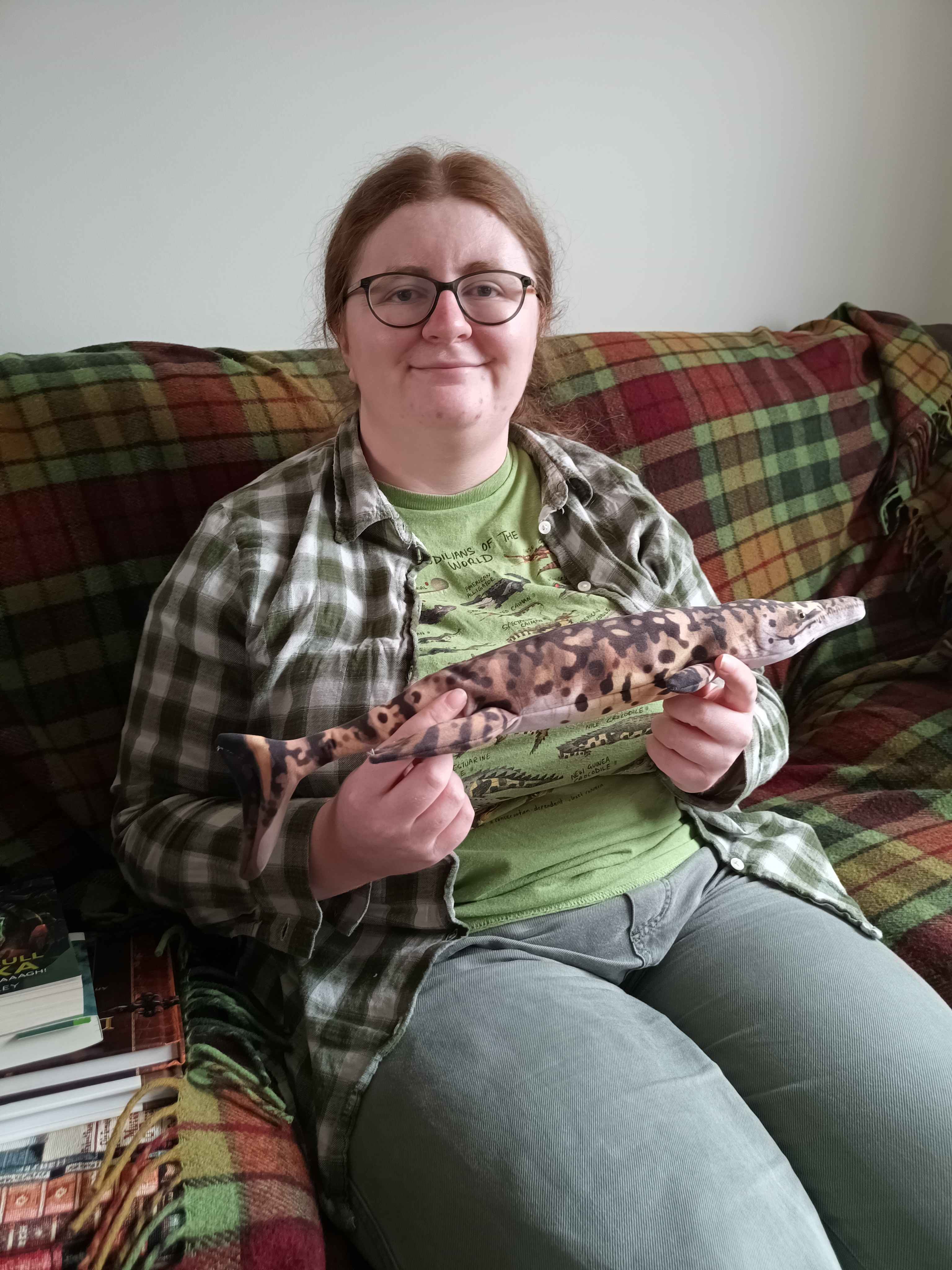
Charlotte Bowman
My research speciality so far has been thalattosuchians; crocodylomorphs from the Mesozoic which became adapted to open ocean environments. During my masters degree we worked on fossils scanned for a Leveheume project; I was supervised by Mark Young and Steve Brusatte. After my masters' I then expanded on my masters' thesis into my first published paper, and continued to coauthor papers for the next few years afterwards.
I hope to get a PhD some day, at present I am employed in a microbiology lab which safety tests food; I enjoy lab work a lot, so when I get back into academia I hope there will be a considerable practical component. For now, I am content with my work on thalattosuchians and I am excited to see where my life takes me next.

Academic Background
Bachelor's degree in Zoology (Newcastle University)
Masters by Research in Palaeontology and Geobiology (University of Edinburgh)
Papers!
Main author of Rostral neurovasculature indicates sensory trade-offs in Mesozoic pelagic crocodylomorphs (Bowman et al. 2021)
My debut paper compared the nerve and blood channels in the skulls of thalattosuchians (ancient crocodylomorphs adapted for life in open ocean) to the nerve and blood channels in modern crocodylians. Crocodylians have special integumentary sensory organs (ISOs)(look for tiny black freckles on their faces!) that they use to detect prey underwater, as their underwater eyesight is poor. Evidence for these ISOs can be seen in crocodylian skulls, which are full of tiny blood and nerve channels to supply the ISOs. In comparison, thalattosuchians have very few blood and nerve channels to supply ISOs, so it is likely they did not have ISOs. They did have large eyes, however, so my paper posits that there was a trade-off between eyesight and ISO sensation.
 Morphosource project for this paper.
Co-author of Evidence for a novel cranial thermoregulatory pathway in thalattosuchian crocodylomorphs (Young et al 2023)
Thalattosuchian crocodylomorphs had a pair of perculiar grooves on the roof of their mouth: these paired grooves may have supplied blood and nerves to organs on the roof of the mouth that could be inflated with blood like a built-in cooling system; modern bowhead whales have a similar cooling mechanism. Nothing for certain can be said yet, the paper is mostly describing and comparing these grooves and exploring possible reasons for them.
Submitted CT data for A new genus of metriorhynchid crocodylomorph from the Lower Cretaceous of Germany(Sachs et al 2024)
I was not directly an author for this one, but I was the one to upload the CT data to morphosource (so I am in the acknowledgements!). (A lot of us are not based physically in the University of Edinburgh buildings, so we have to use the Remote Desktop App to access the system; due to some IT issues at the time I was one of the few people still connected via Remote Desktop, which is why I was asked to help). This paper is about Enalioetes schroederi, who was previously named Cricosaurus schroederi.
Co-author on Thalattosuchian crocodylomorphs from the Sinemurian (Early Jurassic) of the UK (Young et al 2024)
This paper describes a small piece of snout from a basal thalattosuchian from the Sinemurian, which is a very early time period to find thalattosuchians in! This may be a new species or genus, but as it's a small chunk of snout there is not much we can definitely say, so as of yet this is an unnamed species/genus (in case further down the line we discover it is part of an existing genus, or if we find more bones from the same animal). My part in this paper was to use Materialise Mimics to segment all the structures inside the snout - this fossil was riddled with tiny holes and channels!
Submitted CT data for/co-author of Skull sinuses precluded extinct crocodile relatives from cetacean-style deep diving as they transitioned from land to sea (Young et al. 2024)
This paper is an investigation into the sinuses of thalattosuchians, especially when comparing them to cetaceans (whales, dolphins, porpoises etc.). Cetaceans can dive to incredible depths with specialised sinuses filled with a bloody foam, while it is unlikely these fossil crocs could do the same, which gives us some more insight into how they lived (hunting in the water column instead of diving into the deep ocean).
Co-author of The internal braincase anatomy of Thalattosuchus superciliosus, with implications for the endocranial evolution of metriorhynchid crocodylomorphs (Higgins et al. 2024)
This is a close examination of the brain cavity of the metriorhynchid Thalattosuchus supercilliosus. From looking at the brain shape of T. supercilliosus we can use comparitive anatomy to other species to work out what the brain was best suited for - this paper hypothesises that metriorhynchids were evolving to be persuit predators, chasing prey through the water column.
Co-author of Neurosensory evolution in thalattosuchian crocodylomorphs, integrating somatosensory and visual adaptations across ecological transitions (Soni et al 2026)
This paper talks about the different senses that were available to thalattosuchians; such as how they maintained good vision but had reduced somatosensory capabilities. While my first paper described a 'sensory trade-off', this new paper refutes that and takes a more nuanced approach. If you enjoyed my first paper, then this is a must read for updated research! This paper looks specifically at the optic nerve channel, the trigeminal ganglion and the olfactory bulbs of thalattosuchian brains, comparing the braincase anatomy to similar taxa.